UMD SPECIAL COLLECTIONS TOUR
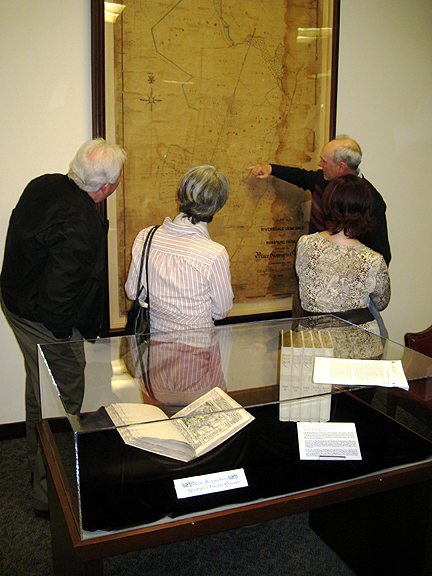
Doug McElrath shows a 19th century map of Calvert estate
Last month, the BHHC had the pleasure to receive a guided tour of the University of Maryland’s special collections at Hornbake Library. Archivist Beth Alvarez started off with a tour of the Katherine Anne Porter room. A Porter enthusiast, Ms. Alvarez happily shared her extensive knowledge of the author’s eventful live. Ms. Porter (1890-1980) is best known for her novel “Ship of Fools” and lived in many places, including Europe and Mexico. But in her last years she occupied an apartment in Westchester Park, just across the street from Berwyn Heights.
Next, Doug McElrath, Curator of Marylandia and Rare Books at Hornbake Library, gave our group a tour of the Maryland Room. He had pulled out a number of documents and maps relating to Berwyn Heights’ history, and gave us an overview of the resources available at the library. This triggered a lively exchange about the research interests of the BHHC and Mr. McElrath, who happens to be a member of the Riverdale Historical Society. The visit ended with BHHC members resolved to come back for more research and with a preliminary agreement to transfer some records to the Maryland Room archive.
WHERE WAS THE SPORTLAND BOXING RING?
BHHC members recently visited the Prince George’s Historical Society Library in Greenbelt to look for information that would help pinpoint the location of the boxing ring that is the subject of this year’s historic marker. They were shown several interesting maps of Prince George’s County, including a hefty 1940 plat book by the Franklin Survey Company. The plat book was once used by a real estate agency and had a wealth of information about the communities it covered. Berwyn Heights is depicted in two detailed plates that show practically every structure in existence at the time.
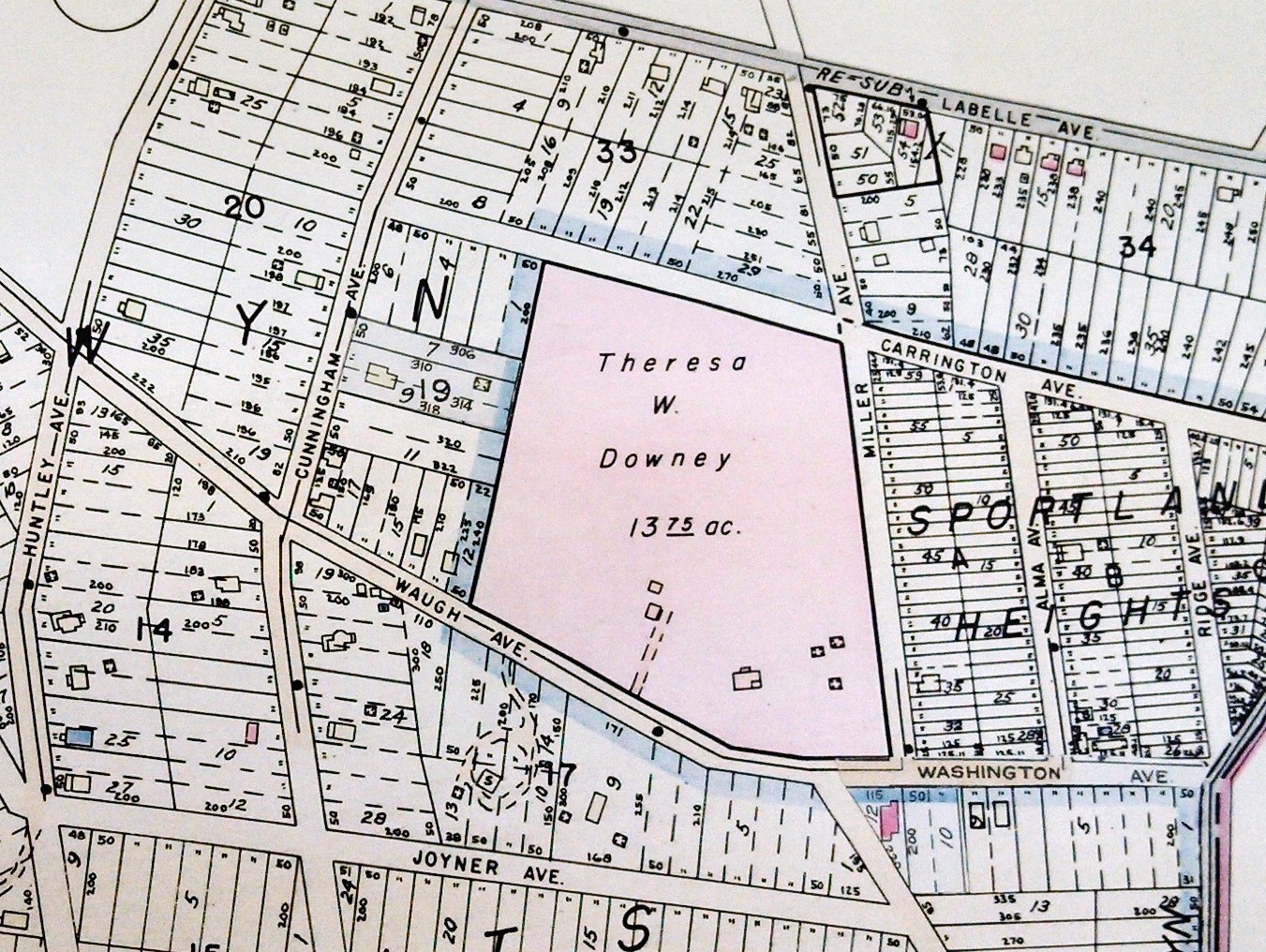
Sportland property in pink,
1940 Franklin Survey plat book
The plate of Berwyn Heights, south side, has the Sportland property. It is under the name of Theresa Downey, who assumed the mortgage for the property from her parents Maria and John O. Waters.
One can clearly see the main house, several outbuildings and a path leading into the property from Waugh Avenue (Berwyn Road). While the boxing ring was no longer in existence in 1940, it is plausible that the ring stood at the end of the path. This squares with the location Ann Harris Davidson reports on page 31 in her book Berwyn Heights: Then & Now: west of the main house in a lower elevation, and with access from Waugh Avenue.
SPORTLAND – A KEY TO THE PAST
People in Berwyn Heights know Sportland as the historic house that sits apart from the rows of ramblers on Natasha Drive. It is also the single best link to a past that predates the founding of Berwyn Heights and goes back to the beginnings of Prince George’s County. Although the home is not grand in comparison to other Prince George’s mansions, it had a number of prominent owners. The house and its owners are described in a Maryland Historical Trust Inventory, authored by county historian Susan Pearl, on which the following is based.
The original dwelling stood on a tract of land named “Yarrow” that James Edmonston (ca 1740 – 1793) inherited from his father, Captain James Edmonston (1699 – 1753).¹ The Edmonstons were an influential family in colonial Prince George’s County. James’ grandfather, Archibald Edmonston (ca. 1670 – 1734), said to be a descendent of Sir James Edmonstone of Duntreath, Scotland,² was one of the wealthiest landowners in Prince George’s County, at a time when it encompassed the areas of Washington, D.C. Montgomery County, and Frederick County.
Yarrow was resurveyed in 1768, and the 522 acre tract was officially patented to James. A record of a house on the property first appears in the federal tax rolls of 1798. At that time, the widow Ruth Edmonston lived there in a modest 1 story frame house with brick chimneys at each gable end. Upon her death, the property passed to her nephew Nathan Edmonston, who sold it to Benjamin and Richard Welsh in 1820. The Welsh family held the land for another 30 years and farmed it with the help of 20 slaves.
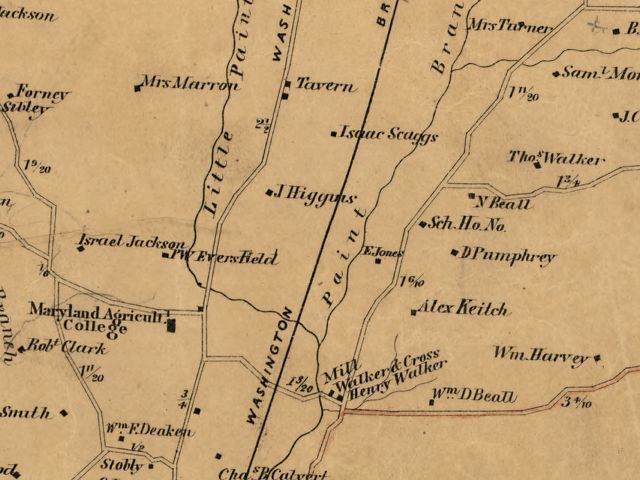
Yarrow and surroundings, 1861
Around 1850, the heirs of Benjamin Welsh sold part of the property to Ethan Allen Jones, who served as a delegate in the Maryland Assembly from 1860 to 1861. Jones was married to Laura Deakins, a daughter of Colonel Leonard Deakins. The Deakins’ owned the Bloomfield farm on which the Town of University Park now stands. The Jones’ built the 2 ½ story addition that is attached to the smaller, original dwelling. Ethan Allen Jones notably served on a commission, which in 1858 established a free school in the Vansville District of Prince George’s County, located a short distance northeast of the Yarrow home.³ An 1861 Martenet map of the area confirms that a school was located in the vicinity of where Pinegrove Academy would be constructed in 1889.
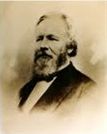
Jonathan T. Walker
Jones died in 1863 and his heirs had to sell the property because of an unpaid debt. In 1865, they sold 274 acres, to Jonathan T. Walker (1811-1885), who owned the estate north of Yarrow. Walker was a builder and successful businessman in Washington D.C., but removed to Prince George’s County when the Civil War broke out. He was also a grandson of Isaac Walker, who had fled Scotland with his brothers Charles and Nathan when a rebellion of Scottish chiefs against King George I of England failed. Upon their arrival in America in 1746, they settled in Prince George’s County, and built a log house they named “Toaping Castle,” after their family stronghold in Scotland. Their house stood where the Golden Triangle in Greenbelt is located today.
In 1869, Walker sold 150 acres of Yarrow, including the house, to Edward C. Carrington. Carrington had fought in the Mexican War and served in the Virginia legislature before being appointed Brigadier General of the District Militia in 1861.4 It was during Carrington’s ownership the property became known as Sportland. In 1874, Carrington sold most of the land to Ada and Elsie Joyner, and they sold it to James E. Waugh, who with Edward Graves, Benjamin Charlton and a group of Washington investors in 1888 established the suburb of Charlton Heights. The Carrington family continued to live at Sportland, which now comprised the house and a much smaller plot of 28 acres, until 1903.
The next proprietor, August Wiegman. divided the property again, selling half to Lillian Hough, who sold it to Maria and John O. Waters in 1915. The Waters held the property until 1937, then conveyed it to their daughter, Theresa Downey and her husband, who owned it until 1951. John Waters is remembered for having opened the controversial Sportland boxing ring in 1922 that is the subject of the BHHC’s 2013 historic marker.
Sources:
MHA inventories PG:67-5 and PG:66-5,
¹Rootsweb entry for James Edmonston
²EFAB-Edmondson Family Association Bulletin
³Acts of the Maryland Assembly, 1858
4Ann Harris Davidson, Then & Now: Berwyn Heights
Author: Kerstin Harper
SPORTLAND BOXING RING
The Berwyn Heights Historical Committee at its last meeting approved a preliminary version of the next historical marker, the Sportland boxing ring. The marker recounts the brief and turbulent history of an open-air boxing arena that John O. Waters operated in Berwyn Heights between 1922 and 1926. Archivist and BHHC chair, Sharmila Bhatia, took on the legwork of researching and writing the initial draft. The BHHC invites public comment until end of February.
2013 WALKING TOUR BROCHURE
Now available: the 2013 edition of the Berwyn Heights Walking Tour Brochure. The brochure is produced by BHHC member and graphic designer M. David Williams and showcases many of the historic homes in Berwyn Heighs.
AN 1897 ELECTION, CONTINUED
More information on the 1897 Berwyn Heights election can be found in the 1898 Session Laws of the Maryland Assembly held at the Maryland State Archives. It seems that the validity of the election was questioned because the election judges were chosen by agreement of the voters rather than being appointed in accordance with the Town charter. The act considered the objections but set them aside to validate the first election. Whether the citizens of Berwyn Heights were heartened by this decision and held a second election remains to be found out.
Volume 482, p.147
CHAPTER 73.
AN ACT to declare valid the election of William DeMott, Edwin A. Alger, and James C. Brelsford, as Commissioners of the town of Berwyn Heights, in Prince George’s County, on the first Monday in May, 1897, and to ratify and confirm the acts done by said Commissioners.
WHEREAS, the Commissioners of the town of Berwyn Heights, in Prince George’s county, failed to appoint three judges to hold an election for commissioners for the town of Berwyn Heights, on the first Monday in May, 1897, as provided for by the Acts of 1896, chapter 267 ; and
WHEREAS, The majority of voters of said town, entitled to vote at said election, by agreement selected John C. Bonnet, John Dove and Mahlen C. Stotzenberg, to serve as judges of said election, and
WHEREAS, The said John C. Bonnet, John Dove and Mahlen C. Stotzenberg, as judges of election, in pursuance of said agreement, held an election for Commissioners of said town on the first Monday in May, 1897, in accordance with the provisions of the Acts of 1896, chapter 267, and at said election William DeMott, Edwin A. Alger and James C. Brelsford were elected Commissioners of said town of Berwyn Heights, in Prince George’s county, for the ensuing year; and
WHEREAS, the validity of said election has been questioned on account of the manner in which said judges were appointed,
therefore,
SECTION 1. Be it enacted by the General Assembly of Maryland, that the election of William De Mott, Edwin A. Alger and James C. Brelsford as Commissioners of the town of Berwyn Heights on the first Monday in May, 1897, at the election held by John C. Bonnet, John Dove and Mahlen C. Stotzenberg, as judges of election, be and the same is hereby declared valid as fully as if the said election had been held by judges appointed in conformity with the Acts of 1896, chapter 267, and the acts done by said Commissioners be and the same are hereby ratified and confirmed.
SEC. 2. And be it enacted. That this Act shall take effect from the date of its passage. Approved March 22, 1898.
AN 1897 ELECTION
In 1976 Don Skarda published the first comprehensive history of Berwyn Heights. Writing about the 1896 incorporation of Berwyn Heights, he said that “the Town charter called for the election of 3 commissioners to serve for one year without pay to administer the affairs of the Town…. Yet for reasons unknown, there is no record that an election of commissioners was ever held or that any other provisions of the charter were ever carried out.” (History of a Small Town, p.21)
If Skarda were writing his history today he probably would have come to a different conclusion. The Internet daily expands our access to all sorts of historic documents and opens new windows on the past. In this case, google books provided access to a source indicating that 3 commissioners were elected in May 1897 and were active for a time, putting into question the widely held belief that the first functioning government of the Town came into being with the election of 1924.
Quoted from Journal of the Proceedings of the Senate of the State of Maryland, p. 892.
“Office of the Secretary of the Senate
March 18th, 1898
The following acts of the General Assembly of Maryland, originating in the Senate, were sealed with the Great Seal, and presented on the 18th day of March, at 11.15 o’clock, A.M., to the Governor of Maryland for approval:
…An Act to declare valid the election of William DeMott, Edwin A. Alger and James C. Brelsford as commissioners of the town of Berwyn Heights, in Prince George’s county, on the first Monday in May, 1897, and to ratify and confirm the acts done by said Commissioners…”
The Act was introduced by William B. Clagett on February 8, 1898, and referred to a Special Committee of Messrs. Clagett, Gray and Bouie. (ibid, p. 220)
Sources: http://www.google.books, History of a Small Town by Don Skarda
Author: Kerstin Harper
BOOKS ONLINE
There are but a few books that deal specifically with the history of Berwyn Heights. Most of them can now be viewed online.
Then & Now: Berwyn Heights, by former Berwyn Heights resident Ann Harris Davidson, published by Arcadia Publishing, 2007
Images of America: College Park by Stephanie Stullich and Katharine Bryant, published by Arcadia Publishing, 2005.
History and Development of the City of College Park, Berwyn Heights, Greenbelt, and Adjacent Areas, from 1745 to 1965, by T. Raymond Burch
THE BERWYN HEIGHTS COMPANY
The Berwyn Heights Company played an important role in the second phase of the Town’s development, lasting from circa 1905 to 1924. BHHC records on the Company are incomplete and leave many questions unanswered. So, any information that adds to our understanding is very welcome.
The Berwyn Heights Building and Improvement Company was incorporated in Washington, D.C. in October 1909 by Fred Benson, Charles Eldridge, William Poultney, William Smyser and Robert Armour for the purpose of developing Berwyn Heights (The Washington Herald, October 23, 1909, Page 11). In the same period, a new streetcar line, the Washington Spa Spring & Gretta Railroad (WSS&GRR) was being constructed to serve the Town. This streetcar company was chartered in 1905 by Samuel S. Yoder, a two term US Congressman from Ohio, who served as its President. Yoder had purchased and was living in the former Waugh mansion on Edmonston Road when Congress was not in session.
Both companies shared the goal to get more people to settle in the town. The streetcar aimed to make it easier to commute to a downtown workplace (the D.C. terminus was at 15th and H Street near the Treasury Department), while the Berwyn Heights Company was advertising and selling land. The Berwyn Heights Company owned land along the tracks but we do not know if there was a formal link between the two ventures or if they operated independently.
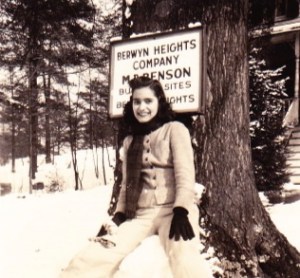
Benson home with Berwyn Heights Company sign, 1940
The young lady is a visiting relative from Panama.
Several of the D.C. residents, who incorporated the Berwyn Heights Company, later moved to Berwyn Heights, where they were instrumental in founding the Berwyn Heights (Citizen) Association. Fred Benson served on the board of directors of the Berwyn Heights Company, and by 1920 was presiding over its board while also serving as President of the Association. Elwood Taylor served as vice president, John McNitt as treasurer, and W.H. Willard as secretary.
After Fred Benson’s death in 1923, his wife Margaret Benson and his sons Howard and Clarence appear to have taken on some of the responsibilities for the business. As late as 1943, Margaret and Clarence Benson’s signatures appear on a deed that conveys land in block 27 owned by the Berwyn Heights Company to the Town for the purpose of extending 58th Avenue (formerly Huntley Ave.) from Tecumseh Street (Newby Ave.) to Greenbelt Road.
Author: Kerstin Harper
Sources: Town records, Library of Congress’ digital archive of historic newspapers
THE BENSONS, CONTINUED
After the death of Fred Benson, who led the Berwyn Heights (Citizen) Association from 1915-21, the Benson family remained a significant presence in Berwyn Heights. As stockholders in the Berwyn Heights (Building & Improvement) Company, Margaret and her son Clarence continued to sell lots in Berwyn Heights. Margaret was active in the Berwyn Presbyterian Church and, in 1940, was the first woman to run for the Berwyn Heights Town Council (then functioning as a Board of Commissioners). She fell short by 2 votes.
The eldest son Howard Livingston Benson (1890-1938) worked as a manager for Chase Bank in several locations throughout Central America. In Panama he married Sarah Veysett and they had 5 children. Howard Benson was on the verge of opening his own bank, when his promising career was cut short by the banking crisis of 1933, during which President Franklin Roosevelt closed all banks to stop the run on banks. The children were sent to live with their grandmother in Berwyn Heights and graduated from Hyattsville High School. Howard followed them later. He was elected to the Berwyn Heights Board of Commissioners in May 1938, but died of a heart attack during a hunting and fishing trip in August 1938.
The second son Clarence C. Benson (1891-1951), a 1914 West Point Graduate, had an illustrious career as a U.S. Army cavalry officer and was a pioneer of tank warfare. During World War II, he served as a combat officer in North Africa and the China-India-Burma theatre and, in 1943, was awarded the Silver Star for distinguished service and the Oak Leaf Cluster for gallantry in action.
 Margeret Benson survived her husband and her three children. She died in Berwyn Heights in 1958 at age 90, and is buried at Rock Creek Cemetery, Washington, D.C.
Author: Kerstin Harper
Sources: James Benson Ancestry.com family tree; Town of Berwyn Heights records
 Berwyn Heights Historical Committee